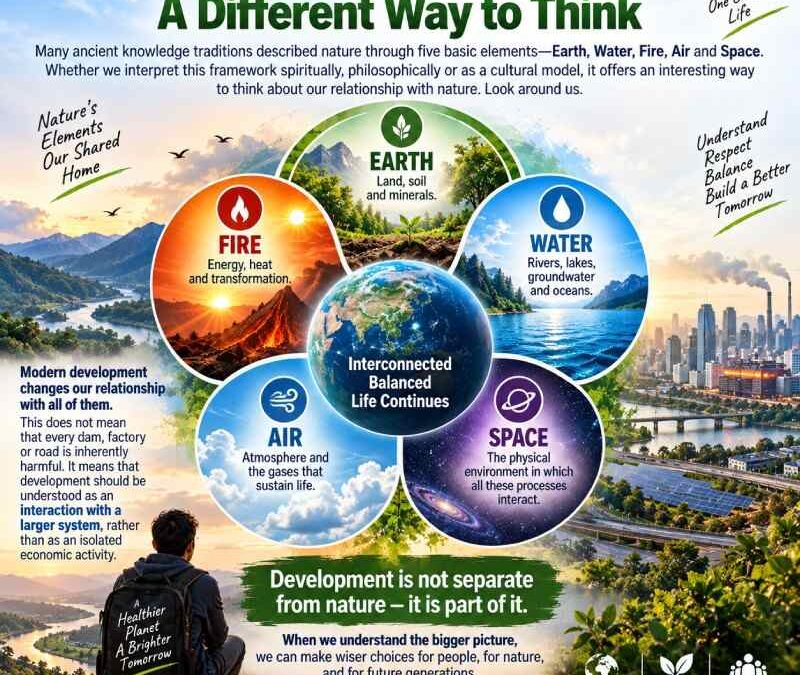
Many ancient knowledge traditions described nature through five basic elements—Earth, Water, Fire, Air and Space.
Whether we interpret this framework spiritually, philosophically or as a cultural model, it offers an interesting way to think about our relationship with nature. Look around us.
Earth — land, soil and minerals.
Water — rivers, lakes, groundwater and oceans.
Fire — energy, heat and transformation.
Air — atmosphere and the gases that sustain life.
Space — the physical environment in which all these processes interact.
Modern development changes our relationship with all of them. This does not mean that every dam, factory or road is inherently harmful. It means that development should be understood as an interaction with a larger system, rather than as an isolated economic activity.
We Are Beginning to Understand the Cost
For a long time, humanity behaved as though nature were an unlimited resource.
Take > Transform > Consume > Discard > Repeat.
But the Earth is not an unlimited warehouse. It is a connected system. When one part changes, other parts can respond.
The challenge before humanity is therefore no longer simply: “How much can we produce?”
It is increasingly: “How much can we produce while maintaining the systems that make life possible?”
That is a very different definition of progress.
#trending #viral #mustread #inspiration #motivational #newrelease #EarthBodyMap #climateJustice #waterconservation #forestprotection #biodiversity
#azimpremji #shivnadar #RohiniNilekani #KiranMazumdarShaw #SafeenaHusain #AnuAga #NikhilKamath #SwamiSivananda
#HumanIntelligence #GenerationalWisdom #LearningTogether #ExperienceAndInnovation #ConsciousLeadership #DigitalHumanity #ThinkBeyondData #WisdomAndGrowth #FutureOfHumanity #SharedLearning