Is it coming from the body—or from knowledge?
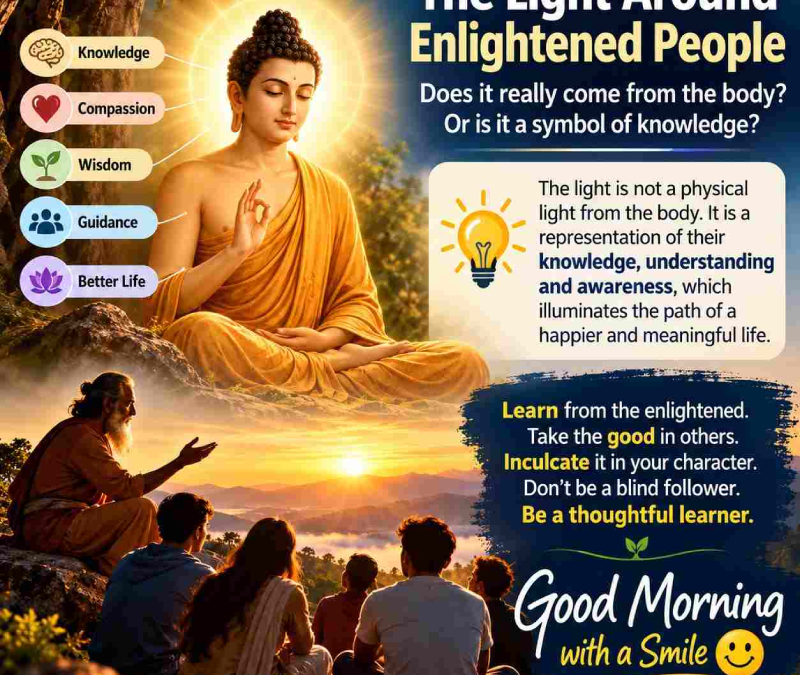
We have all seen paintings, sculptures and images of enlightened, spiritual or highly revered people. A common feature immediately catches our attention: A circle of white or golden light appears around the head, sometimes around the entire body.
For generations, we have looked at that light and accepted an interesting idea: “The light is coming from the body because the person is enlightened.”
But perhaps we should stop for a moment and ask a simple question: What if the light was never meant to be understood as physical light? What if it was created as a symbol? What if the artist was trying to tell us something much deeper: This person has knowledge that can illuminate the path of life for others. That changes the way we understand enlightenment.
LIGHT HAS ALWAYS BEEN A SYMBOL OF KNOWLEDGE
Think about the language we use even today.
We say: “He showed me the light.”
We say: “I finally saw the light.”
We say: “Knowledge removes darkness.”
We say: “Education is the light of life.”
Nobody normally means that a person has produced physical sunlight. The “light” represents understanding. Darkness represents ignorance, confusion, fear and lack of awareness.
Light represents clarity, knowledge, wisdom and awareness.
Therefore, when an enlightened person is shown with light around the head, perhaps the message is not: “Look at the physical light coming from this person's body.” Perhaps the message is: “Look at the knowledge and awareness this person carries.”
THE HEAD IS NOT DECORATED—IT IS SYMBOLIC
Why is the light so often shown around the head?
Because the head represents the centre of:
- Thinking
- Understanding
- Awareness
- Knowledge
- Observation
- Discrimination
- Wisdom
The artist may therefore be communicating an idea without using words: “This person's understanding is illuminating.” The light becomes a language of its own. It tells us that the person has moved beyond merely collecting information. They have understood something deeply and are able to share that understanding with others.
ENLIGHTENMENT SHOULD NOT BECOME A BLIND-BELIEF SYSTEM
This distinction is important.
If we believe that enlightenment means that somebody's physical body actually produces a supernatural white or golden light, we may begin looking for miracles instead of looking at the person's knowledge, conduct and contribution.
We may start asking: “Can this person perform something extraordinary?”
Instead, perhaps we should ask: “What did this person understand?” “What did they teach?” “Did their knowledge reduce fear?” “Did their wisdom improve human relationships?” “Did their teachings encourage compassion, responsibility and awareness?” “Can their ideas help us live a happier and more meaningful life?”
These questions bring enlightenment back from the world of mystery into the world of human understanding and experience.
Light is more than what we see
Light is not only something to be seen; its energy is also experienced through its effects.
The best example is the Sun.
We see its light, but we also feel its warmth. Its energy reaches us, supports life, drives natural processes, and sustains the living world. Perhaps the same idea can help us understand the symbolic light around an enlightened person.
The aura is what we see. But the knowledge, wisdom and awareness are what we experience through the person's words, actions and influence. We may not be able to physically see someone's knowledge, but we can feel its effect when it brings clarity to confusion, wisdom to our decisions, peace to our mind, and direction to our life.
In that sense, the real question is not: “Can we see the light around the person?”
It is: “Can we feel the light of their knowledge in the way we understand and live our life?”
THE REAL LIGHT MAY BE THE LIGHT WE RECEIVE
Imagine walking through a completely dark road. Someone comes with a lamp. The lamp may not remove every obstacle from your journey. But it allows you to see the path. The person has not walked the journey for you. They have simply provided enough light for you to see where you are going.
Perhaps this is one of the most beautiful ways to understand an enlightened teacher. They do not necessarily live our life for us. They do not make every decision for us. They do not remove every difficulty from our path. Instead, their knowledge may help us see more clearly. And once we can see clearly, we can choose our own path. That is why perhaps the greatest gift of an enlightened person is not following. It is understanding.
WE SHOULD NOT BECOME FOLLOWERS OF THE PERSON—WE SHOULD FOLLOW THE LIGHT OF KNOWLEDGE
There is a subtle difference between these two ideas. A follower may say: “Whatever my teacher says must be true.”
A thoughtful learner may say: “Let me understand what my teacher is saying, examine it, experience it and learn what is useful.”
The first can create dependence. The second can create awareness. This is why respect should never require the surrender of our reasoning. We can deeply respect someone without blindly accepting everything associated with them. We can admire their wisdom without copying their personality.
We can learn from their life without becoming a replica of their life. Take the good. Understand it. Test it in your own life. And make it part of your own character. That, perhaps, is a much more meaningful form of respect.
THE LIGHT DOES NOT BELONG TO ONE PERSON
There is another important thought. If the light represents knowledge, then it does not belong exclusively to the enlightened person. The person may have discovered something. They may have understood something before us. They may have shown us a direction. But eventually, we have to light our own lamp.
A teacher can show us the path. A book can provide knowledge. A researcher can provide evidence. A philosopher can provide questions. A spiritual teacher can provide a framework for reflection. But understanding must eventually happen within us. Nobody can become enlightened on our behalf. Nobody can think on our behalf. Nobody can live our life on our behalf.
FROM MYTH TO MEANING
Perhaps we should not reject the beautiful images of halos and divine light. Instead, we can understand them at a deeper level. Art often communicates ideas through symbols. A halo can represent holiness, wisdom, purity or spiritual significance depending on the tradition and context.
The important question is not: “Did the artist photograph physical light coming from the person's body?” The more meaningful question is: “What was the artist trying to communicate?”
Perhaps the answer is: “This person carries a light of understanding.” And that understanding may illuminate the lives of others.
KNOWLEDGE BECOMES LIGHT ONLY WHEN IT IS USED
There is also a danger in confusing information with wisdom. A person can possess enormous amounts of information and still create confusion. Knowledge becomes meaningful when it changes the way we see and live.
If knowledge makes us more: aware rather than arrogant, compassionate rather than judgmental, logical rather than superstitious, peaceful rather than aggressive, responsible rather than careless, then knowledge has begun to become wisdom. And when wisdom helps another person find clarity, it becomes light for someone else's journey.
THE REAL TEST OF ENLIGHTENMENT
Perhaps the real test is therefore not the halo. It is the life behind the radiance. Not the colour surrounding the body. But the quality of understanding within the person.
Not how many people follow them. But how many people become capable of thinking more clearly because of them.
Not how extraordinary they appear. But how much good their understanding creates. Not whether we can see a supernatural light. But whether their knowledge helps us see the ordinary realities of life more clearly.
AND PERHAPS THIS IS THE MESSAGE FOR ALL OF US
We do not have to become an enlightened master to carry some light. Every human being can become a small source of light for another person.
A teacher can illuminate a student's mind. A parent can illuminate a child's path. A friend can provide clarity during confusion. A researcher can illuminate an unknown subject. A counsellor can help someone see a new possibility. A kind person can bring light into somebody's difficult day. We may never have a halo around our head. We may never be called enlightened.
But if our knowledge, behaviour and compassion help another human being see life more clearly, then perhaps we are carrying a little light of our own.
SO, WHAT IS ENLIGHTENMENT?
Perhaps enlightenment is not about having light around us. Perhaps it is about creating light within us and sharing it through our understanding and actions.
The radiance is an image. The knowledge is the substance. The light is the symbol. The transformation is the real journey. And the ultimate purpose of knowledge should not be to make us superior to others. It should make us more aware, more humble, more compassionate and more useful to humanity.
So, the next time we see an enlightened person surrounded by a beautiful white or golden light, perhaps we should pause and look beyond the picture.
Instead of asking: “How did the light come out of the body?”
Let us ask: “What did this person understand that can illuminate my path?”
Because perhaps the greatest light an enlightened person can give us is not the light around them. It is the light they leave within us.
Learn from the enlightened. Understand the knowledge. Take what is good.
Make it part of your character. And then become a light for someone else.
#Enlightenment #KnowledgeIsLight #Wisdom #Awareness #Spirituality #Humanity #ThinkAndUnderstand #LifeWisdom #ConsciousLiving