
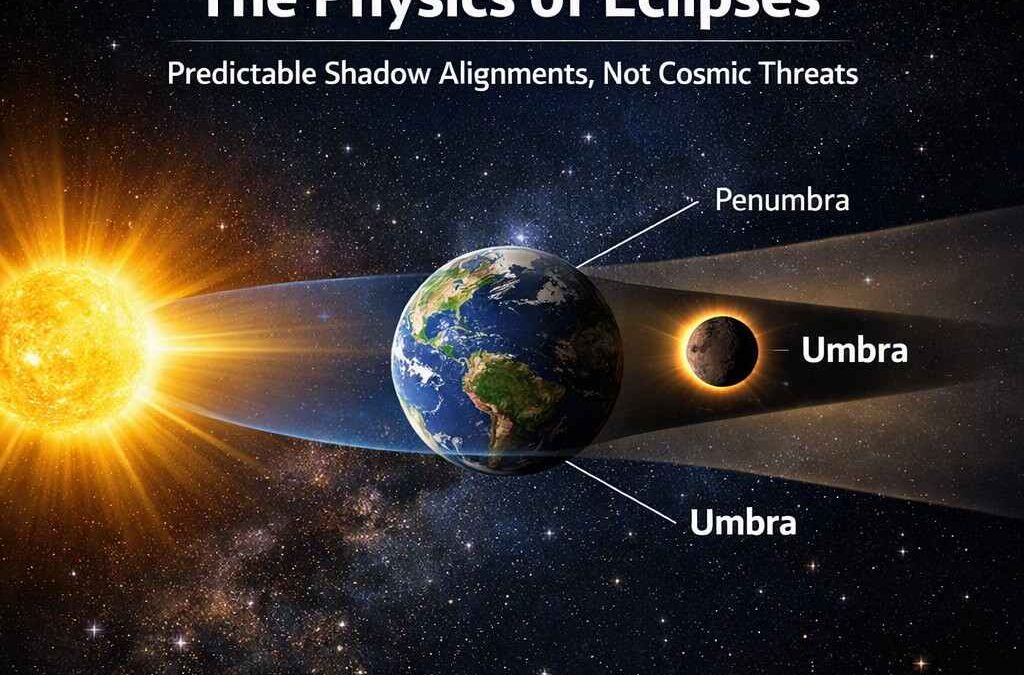
In ancient times, the sudden darkening of the Sun during the day or the Moon at night was deeply frightening. Without modern scientific knowledge, people believed invisible entities were "swallowing" the sources of light. Today, the laws of astronomy offer complete clarity.
An eclipse can only occur when two conditions align simultaneously:
- Linear Alignment (Syzygy): The Sun, Earth, and Moon line up in a straight line (New Moon or Full Moon).
- Nodal Proximity: The Moon is positioned near Rahu or Ketu.
The Geometry of Shadows:
When the Moon passes directly between the Sun and Earth near a node, its shadow falls on Earth (Solar Eclipse). When the Moon passes into Earth's shadow behind us, the Moon darkens (Lunar Eclipse).
If the Moon is far from Rahu or Ketu during a Full or New Moon, its 5.14∘ tilt causes its shadow to pass above or below Earth entirely, resulting in no eclipse.
Mathematical Data:
- Nodal Precession: The line connecting Rahu and Ketu slowly rotates backward, completing a full 360∘ cycle in exactly 18.6 years.
- The Saros Cycle: Astronomers discovered that after 223 synodic months (18 years and 11 days), the Earth, Moon, and Nodes return to almost the exact same relative geometry, causing near-identical eclipses to repeat predictably.
An eclipse is purely a game of optical shadows—as natural and calculable as a shadow cast by a tree canopy on a sunny afternoon.
Join the Discussion: Have you ever witnessed a total or partial solar eclipse in person? How did it feel when the daytime temperature suddenly dropped or the sky darkened? Share your experiences and photos below!
#FromMythToLogic #RahuAndKetu #AstronomyOverSuperstition #RationalThinking #CriticalThinking #ScienceAndLogic #DebunkingMyths #CosmicGeometry #HumanAgency #SelfReliance #MindsetShift #EducationalSeries