Inventions, innovations and research were created to make human life easier, safer and better.
But somewhere along the way, we changed their purpose.
We created — and then commercialised. We discovered — and then competed. We innovated — and then used innovation to defeat others. We developed technology to serve humanity — and gradually made humanity dependent on technology.
So the question is not: “What did we pay for our progress?”
The deeper question is: “What did we turn our progress into?”
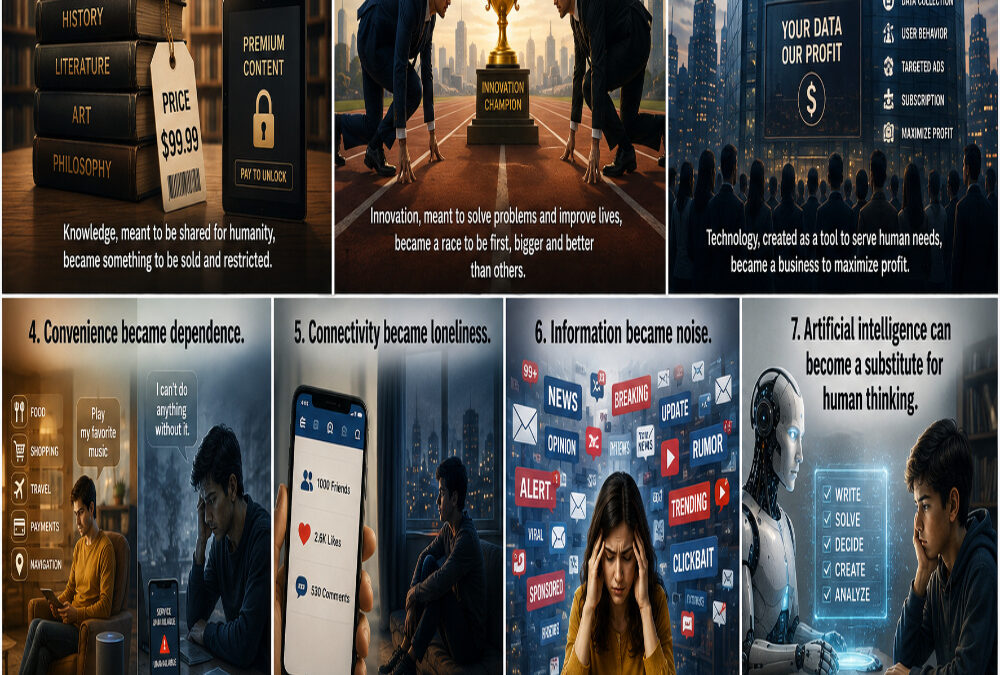
Knowledge became a product. Innovation became a competition. Technology became a business. Convenience became dependence. Connectivity became loneliness. Information became noise. Artificial intelligence can become a substitute for human thinking. The objective of invention was to improve life.
But when the objective becomes profit, power, control and defeating the competition, the original purpose is lost.
Yet, it is not too late. We still have time to bring balance between technology and humanity, convenience and capability, knowledge and wisdom, progress and peace.
The future does not require us to reject inventions. It requires us to change the purpose for which we use them.
Let us not stop creating. Let us stop misusing what we create.
Because if we do not restore this balance now, one day we may have everything that makes life comfortable— but lose the very things that make life worth living. Progress without humanity is not progress. It is only advancement. The time to balance is now. Before it is too late.1. Knowledge became a product: Knowledge was meant to be shared so that humanity could grow together. We gradually turned it into something to be purchased, controlled and commercially protected, sometimes making access to knowledge dependent on one's ability to pay.
2. Innovation became a competition.: Innovation was meant to solve problems and improve lives. Instead, it often became a race to be first, bigger and more powerful—where defeating the competitor can become more important than serving humanity.
3. Technology became a business.: Technology was created as a tool to serve human needs. But when every human need becomes a market opportunity, technology can start creating new dependencies simply to sustain consumption and profit.
4. Convenience became dependence.: Machines were invented to save our time and effort. Gradually, we started depending on them so much that we sometimes lose the confidence and ability to do things ourselves.
5. Connectivity became loneliness.: Technology has connected billions of people across distances. Yet being constantly connected through screens does not necessarily mean being emotionally connected; we can have hundreds of contacts and still have nobody with whom we can truly share ourselves.
6. Information became noise.: The world has never had access to so much information. But when information comes continuously from every direction, knowledge can get buried under opinions, distractions, notifications and misinformation—and silence becomes increasingly rare.
7. Artificial intelligence can become a substitute for human thinking.: AI can be a powerful assistant that expands human intelligence and creativity. But if we begin asking machines to think, decide, create and express everything for us, we may gradually lose the habit of questioning, imagining and thinking independently.
The real question is not whether progress is good or bad. The question is whether we are using progress to strengthen human beings—or slowly replacing the very qualities that make us human.