For generations, families across cultures—particularly within the traditions of Vedic astrology—have approached the milestone of marriage with a meticulous checklist. Central to this process is the ancient system of Ashtakoot Milan, where a prospective couple's horoscopes are evaluated across eight categories totaling a maximum score of 36 Gunas (traits).
When the final tally hits close to 36, sighs of relief echo through the room. Families celebrate, treating the high score as an astrological green light and a cosmic guarantee of a blissful, friction-free life ahead.
Yet, anyone who has navigated the raw, everyday realities of long-term commitment knows a quiet truth: The math of astrology does not equal the magic of a lived partnership.
As the saying goes:
“The strength of a marriage is determined not by the number of matching traits, but by the ability to understand differences and make them complementary.”
The Illusion of the Perfect Score
A high guna score measures baseline energetic harmony, emotional alignment, and temperamental overlaps. It tells us how similarly two minds might naturally react to the world. But identical traits do not a partnership make. In fact, matching 36 out of 36 points is no absolute insurance policy against heartbreak, misunderstanding, or drift.
Why? Because human beings are not static charts; they are dynamic, evolving souls.
When two people are mirror images of one another—sharing identical strengths, blind spots, and temperaments—they often find themselves ill-equipped when life introduces friction. Two hot-tempered individuals, no matter how astrologically aligned, will only amplify each other's fire. Two overly cautious planners may freeze entirely when faced with sudden, unpredictable crisis. Similarity offers comfort, but difference offers growth.
Embracing the 36 Variations
Instead of dreading our differences or treating them as compatibility red flags, we need a paradigm shift.
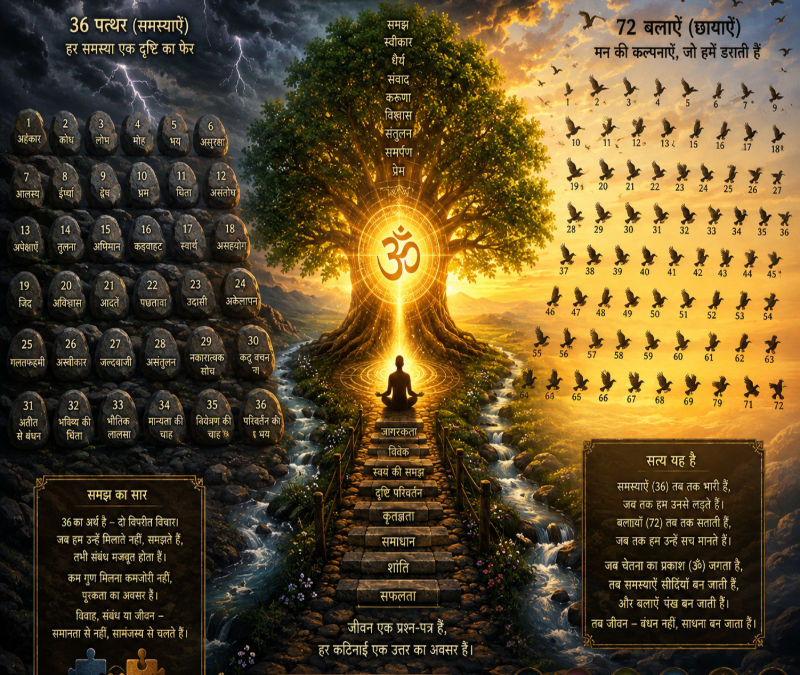
“Matching 36 traits is not a guarantee of marriage; understanding 36 differences is the true test of marriage.”
Real, enduring love is forged in the space between two different people. It is found in how a naturally expressive partner learns to give a reserved spouse space to breathe, and how a quiet realist teaches an ambitious dreamer how to anchor their feet on the ground.
Navigating a life together means confronting dozens of daily variances:
- Communication Styles: One speaks out immediately in anger; the other retreats to process quietly.
- Decision-Making: One relies strictly on logic and spreadsheets; the other listens deeply to intuition and emotion.
- Pace of Life: One thrives on constant motion and social connection; the other recharges in solitude and stillness.
These are not flaws to be corrected; they are distinct puzzle pieces. Left scattered, they cause sharp edges and friction. But when assembled with patience, empathy, and active listening, they click together to form a complete picture.
The Art of Becoming Complementary
Compatibility is not something you passively find in a horoscope chart; it is something you actively build through daily emotional labor.
- Curiosity Over Judgment: When your partner reacts to a situation entirely differently than you would, resist the urge to correct them. Instead, ask yourself: What does their perspective protect or illuminate that mine misses?
- Bridging the Gaps: Treat your differences as a team asset. If one partner excels at macro-vision and the other at detail-oriented execution, stop competing and start collaborating.
- Grace Under Pressure: The true test of a bond isn’t how smoothly things run when life is easy, but how gracefully you hold space for each other when beliefs clash, stress peaks, and personalities rub raw.
Looking Forward
Astrology can offer a fascinating blueprint, but the architecture of a happy home is built by human hands. The magic of marriage doesn't lie in sharing identical traits; it lies in the willingness to say: "We are not the same, and that is our greatest superpower."
When we stop searching for a replica of ourselves and start embracing the unique complexities of our partner, we move away from chasing a theoretical score—and toward building a real, resilient love.
What is one major difference between you and your partner that you’ve learned to turn into a strength rather than a hurdle?
#RelationshipWisdom #ConsciousLove #PartnershipGoals #BeyondTheNumber #DeepConnections #ArtOfRelationships #36Gun #AstrologyForMarriage