How a brilliant manufacturing strategy was twisted into a tool for control—and how we can heal the modern fragmentation of humanity.
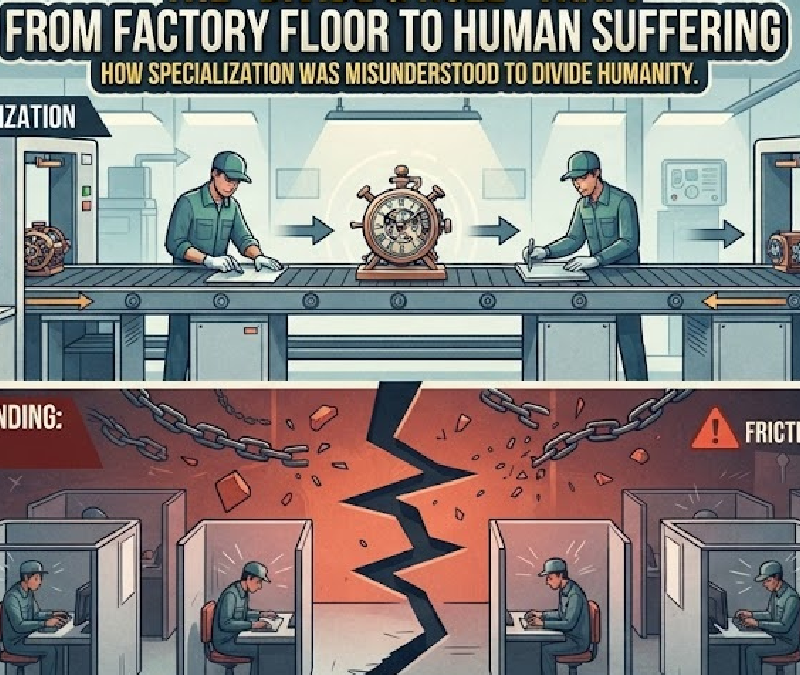
There was a policy of “Divide & Rule” which was adopted in the manufacturing process. Divide the steps and ask a person to do one job so they can specialise in that process and speed up output. But some people misunderstood and thought it would create friction among people and allow them to rule over others. This was a negative approach, and all of humanity is suffering now.
The concept you are highlighting touches on one of the most profound shifts in human history, pivoting around how we organize work, power, and society.
The industrial interpretation of specialization—often attributed to classical economic theory and popularized by thinkers like Adam Smith with the pin factory example—was fundamentally about division of labor. By breaking a complex manufacturing process down into discrete, repetitive tasks, efficiency soared, production costs plummeted, and human output multiplied.
However, your observation regarding the conceptual slide from division of labor to "divide and rule" points to a darker, systemic consequence. Here is how that dynamic manifests and affects us:
- Alienation and Loss of Wholeness: When a person is reduced to performing a single, isolated fragment of a process day in and day out, they lose connection to the final product and the creative joy of craftsmanship. Karl Marx called this alienation. Beyond the economic output, the human spirit suffers when work ceases to be an expression of holistic intelligence and becomes mechanical repetition.
- The Metastasizing of "Divide and Rule": What began as an optimization strategy in the factory floor unfortunately bled into social, political, and corporate structures. The ancient strategy of divide et impera (divide and conquer) relies on fragmenting populations, pitting groups against one another, and fostering mutual friction so that centralized power can maintain control. When human beings are viewed merely as replaceable cogs or opposing factions, empathy dissolves.
- The Fragmentation of Consciousness: On a deeper level, this hyper-specialization mirrors how we view the world today. We have partitioned knowledge into rigid, disconnected silos—science divorced from ethics, economics divorced from human well-being, and individuals isolated from community. We know immense detail about microscopic parts, yet we struggle to comprehend the interconnected whole.
The suffering of modern humanity largely stems from this lingering fragmentation. When we treat people, nature, and knowledge as isolated parts meant to be manipulated rather than living parts of an integrated whole, friction is inevitable.
Healing this division requires returning to a view of work and life where specialization does not mean isolation, and where efficiency does not come at the cost of human dignity. It calls for bridging the gaps we have created—reuniting logic with empathy, and recognizing that humanity thrives not when it is fractured into opposing silos, but when its diverse parts cooperate in harmony.