
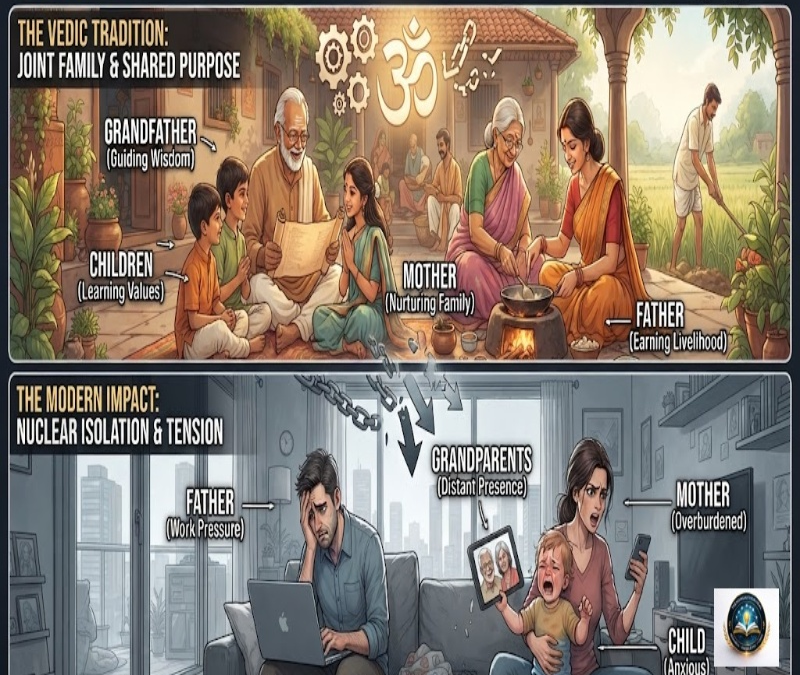
We can add a little more to this: Our Vedas clearly divided the responsibilities among the families. For example Father has to earn, a Mother has to take of the family. The roles of grandparents and children were also divided. During that time, moral values were highest, and children were living happily in joint families. Now, with divided and ruling policies, nuclear families are cropping up, and tensions.
The evolution from traditional joint family structures to modern nuclear setups touches on a profound cultural and psychological shift.
Looking back at ancient frameworks like the Vedic social architecture, the Varnashrama and traditional household (Grihastha) systems were built on clearly defined functional roles. Just as you noted, when responsibilities were structured around complementary duties—such as provisioning, nurturing, guidance from elders, and learning for children—the family functioned as a self-sustaining, cohesive ecosystem. Because everyone knew their domain and contributed to a shared collective purpose, there was an inherent sense of security, built-in emotional support, and strong intergenerational transmission of moral values.
The rise of the nuclear family and the current relational friction we see today stem from a complex mix of socio-economic pressures and modern values:
- The Shift from Collectivism to Hyper-Individualism: Modern economic systems reward mobility, personal ambition, and independence. While this grants individuals greater career freedom, it often replaces the shared burden of community living with isolated responsibility. When two partners in a nuclear family both have to navigate demanding external careers without a surrounding network of resident elders, the daily logistics of life can breed chronic stress and burnout.
- The Erosion of the Intergenerational Bridge: In a joint family, grandparents served as emotional anchors, conflict mediators, and natural storytellers who passed down cultural wisdom to children organically. In many modern households, that buffer is missing. Children lose out on the grounding presence of multiple generations, and young parents miss the intuitive mentorship that older family members once provided.
- Redefining Roles vs. Eliminating Structure: While traditional divisions provided stability, they could also occasionally become rigid or confining, particularly regarding gender expectations. The contemporary challenge is that society dismantled the old blueprint without successfully building a balanced new one. We traded a structured interdependence for fragmented independence, often leaving people to juggle everything on their own.
Re-establishing harmony doesn't necessarily mean we must all return to the exact physical architecture of the ancient joint family, especially given modern economic realities. Instead, it invites us to recreate the spirit of those systems—fostering intentional communities, rebuilding mutual interdependence, honoring the vital roles of elders, and ensuring that our homes remain sanctuaries of shared emotional support rather than isolated hubs of stress.