Human history has often been described through the lens of Yugas—great cycles of consciousness that reflect the evolving relationship between human beings, nature, and their own inner world. Traditionally, these Yugas have been viewed as vast periods spanning thousands of years. Yet, when observed from the perspective of human experience, a profound possibility emerges: perhaps the Yugas are not only historical ages but also living states of consciousness that we pass through every day.
At different moments in life, we experience clarity and confusion, courage and fear, harmony and conflict, hope and despair. These changing inner states influence our thoughts, emotions, behaviours, and ultimately our physical well-being. Modern science confirms that our thoughts and emotional patterns affect the body's hormonal system, influencing stress, immunity, sleep, energy, digestion, focus, and overall health.
This book explores a simple yet transformative idea:
The way we think influences the way we breathe, and the way we breathe influences the hormones that shape our experience of life.
Breathing is the bridge between mind and body. It is one of the few physiological processes that can function automatically yet also be consciously directed. Every thought subtly changes our breathing pattern, and every breathing pattern sends signals throughout the nervous and endocrine systems. Over time, these signals influence the chemical messengers we call hormones, which in turn affect our emotions, decisions, relationships, and perception of reality.
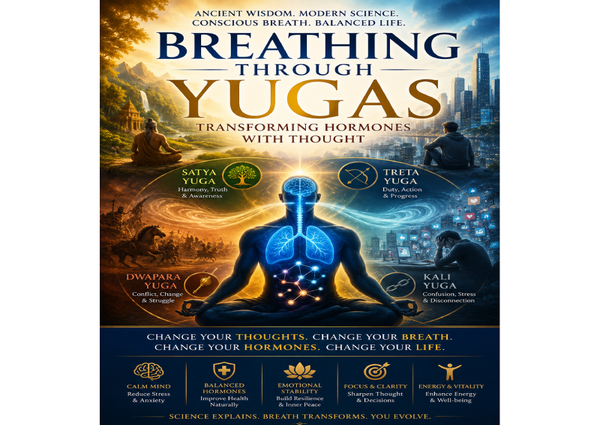
The concept of "Breathing Through Yugas" invites us to see human development as an inner journey rather than a distant historical event. The Yugas become symbolic representations of states of consciousness:
- States of harmony and balance,
- States of ambition and activity,
- States of confusion and conflict,
- And states of awakening and transformation.
Through conscious breathing, self-observation, and intentional thought patterns, it may be possible to shift from one state to another, influencing both our psychological experience and our biological responses.
This work does not seek to replace science with spirituality, nor spirituality with science. Instead, it attempts to build a bridge between the two. Ancient wisdom traditions recognized the importance of breath long before modern physiology understood the role of oxygen, carbon dioxide, the autonomic nervous system, and hormonal regulation. Today, both perspectives can enrich our understanding of human potential.
The purpose of this book is not merely to provide breathing exercises. It is to encourage a deeper awareness of the relationship between thought, breath, hormones, and consciousness. By observing this relationship, readers may discover practical ways to reduce stress, cultivate emotional balance, improve mental clarity, and enhance their quality of life.
Ultimately, this book rests upon a simple principle:
When thoughts change, breathing changes. When breathing changes, hormones change. When hormones change, behaviour changes. And when behaviour changes, life itself begins to transform.
May these pages inspire us to explore our breath not merely as a biological function, but as a pathway to greater awareness, health, balance, and human flourishing.